Electrician Apprenticeship
Electrician Apprenticeships combine paid on-the-job training with formal study, giving apprentices the skills and practical experience to install, maintain, repair and test electrical systems across residential, commercial and industrial settings.
During an electrical apprenticeship, apprentices work alongside qualified electricians while completing formal training and developing practical skills in areas such as wiring, fault finding, testing, commissioning and electrical maintenance.
Qualified electricians are employed across industries including construction, manufacturing, mining and resources, infrastructure and renewable energy, with strong demand for skilled tradespeople throughout Australia.
Completing an electrician apprenticeship can lead to becoming a licensed electrician, opening the door to long-term career opportunities, strong earning potential and the option to progress into supervisory roles or run your own business. Read more about how to find an electrical apprenticeship.
What Does an Electrician Do?
Electricians install, test, maintain and repair the systems and equipment that power homes, businesses, industrial facilities and major infrastructure projects.
Day-to-day work can include:
- Installing wiring, switchboards, lighting and power outlets
- Diagnosing electrical faults and repairing equipment
- Reading and interpreting blueprints, wiring diagrams and technical specifications
- Testing systems to ensure safety and compliance
- Commissioning new equipment and machinery
- Maintaining motors, generators and industrial control systems
Depending on the certificate and practical specialisation completed, an electrician may work in businesses that manufacture or repair electrical equipment, maintain electronic devices, or run their own small business as an electrical contractor.
An electrician's work is essential for ensuring electrical systems run safely and efficiently, and the role is critical across construction, maintenance, mining and resources, and energy industries.
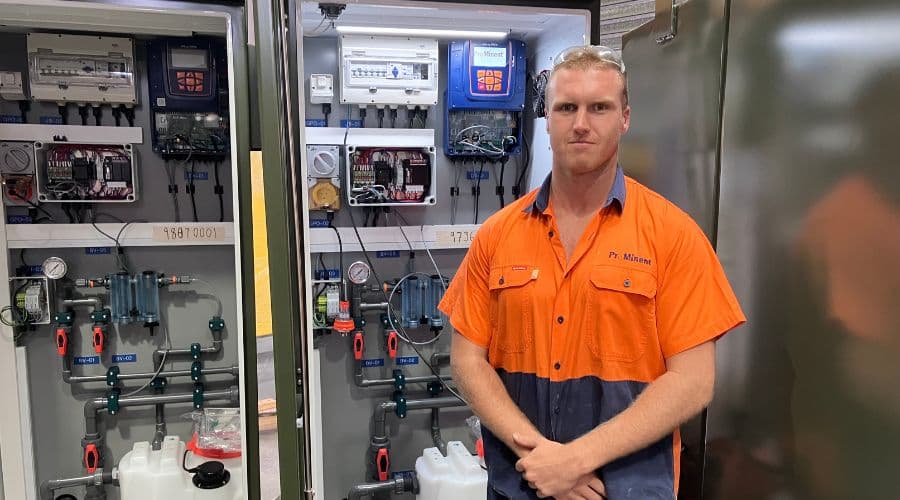
Joshua completed his Electrician Apprenticeship with MIGAS, gaining her on-the-job training with host company ProMinent.
How Long is an Electrician Apprenticeship?
The typical length of an electrical apprenticeship is four years.
During your training you'll be paid to work and gain hands-on experience under the supervision of qualified electricians, while completing a nationally accredited qualification such as a UEE30820 Certificate III in Electrotechnology Electrician at TAFE or a Registered Training Organisation.
On successful completion, you'll be qualified to apply for an electrical licence in your state or territory, which is required to work as a fully qualified electrician in Australia.
Some apprentices, particularly in the mining and resources sector, choose to complete a dual trade Electrical and Instrumentation Apprenticeship, which takes around five years and provides additional training in instrumentation, process control and industrial automation systems.
Electrician Salary
Qualified electricians in Australia can earn strong wages, with salaries varying depending on industry, location and specialisation. On average, a qualified electrician can earn between $95,000 and $115,000 per year. (Seek)
Electrician Apprentice Wages
As an apprentice electrician, you'll typically be paid under the Electrical, Electronic and Communications Contracting Award or an EBA provided by your employer. Your actual pay will depend on whether you've completed Year 12, whether you're an adult apprentice, any EBA terms, employer or host benefits, and relevant government support.
Indicative Award wages for an electrical apprentice as at 1 July 2026, ranging from 1st year to 4th year:
- Junior apprentice, did not complete Year 12: $622.72 to $1,006.97 per week
- Junior apprentice, completed Year 12: $682.76 to $1,006.97 per week
- Adult apprentice (21 years and over): $982.95 to $1,098.29 per week
Rates include industry allowance, tool allowance and electrician's licence allowance. (Source: Fair Work Ombudsman Pay Guide MA000025) Read more in our 2026-27 Apprentice Wages Guide.
Electrician qualifications are included on the Government's Australian Apprenticeship Priority List, providing additional financial assistance to eligible apprentices.
Skills and Requirements
To succeed as an apprentice electrician, you'll need a mix of technical aptitude and practical attributes:
- Technical skills: A good understanding of basic maths and the ability to grasp electrical concepts, read blueprints, wiring diagrams and technical manuals
- Physical fitness: The job involves lifting, working in confined spaces, climbing ladders, and standing for long periods
- Attention to detail: Electrical work demands accuracy. Small mistakes can have serious safety consequences
- Problem-solving: You'll need to diagnose faults and resolve electrical issues quickly and efficiently
- Safety consciousness: Knowledge of and respect for safety rules and regulations is non-negotiable in this trade
- Adaptability: The electrical industry evolves constantly, particularly with the growth of renewables and smart technology, so a willingness to keep learning is essential
Most employers and Registered Training Organisations expect candidates to have completed Year 12 with passes in Maths and English.
Some host employers, particularly in mining and resources, also require candidates to pass a pre-employment medical and drug and alcohol screening.
Career Pathways After Your Apprenticeship
Once qualified, electricians can specialise or move into related fields, including:
- Industrial and commercial electrical work
- Mining and resources electrician
- Instrumentation and control
- High voltage electrical work
- Solar and renewable energy installation
- Electrical contracting and running your own business
- Electrical engineering (with further study)
- Site supervision, project management and estimating
The trade qualification you gain through your apprenticeship is the foundation. Where you take it from there is up to you.
Find an Electrician Apprenticeship
Ready to learn the skills you need to become a qualified electrician? Apply for an electrical apprenticeship with MIGAS and start your career in one of Australia's most in-demand trades.
We employ school leavers and mature-aged electrician apprentices, so whether you're fresh out of high school or looking to make a career change, start your career in the electrical industry.
Latest Apprenticeships
Electrician Apprenticeship FAQs
Want to learn more? Read our frequently asked questions about electrician apprenticeships, qualifications and career pathways.