Electrical and Instrumentation Apprenticeship
An Electrical and Instrumentation (E&I) Apprenticeship is a five-year dual trade pathway that qualifies technicians to work across electrical and control systems in large-scale industrial operations.
Training leads to two nationally recognised qualifications, the UEE30820 Certificate III in Electrotechnology Electrician and the UEE31225 Certificate III in Instrumentation and Control. Apprentices gain hands-on experience in installation, commissioning, maintenance and fault-finding across motors, pumps, compressors, generators and automated processing equipment.
Electrical and Instrumentation Technicians work across mining, oil and gas, power generation, water treatment, manufacturing, food processing and pharmaceutical industries, supporting the automation and control systems critical to industrial operations.
What Does an Electrical and Instrumentation Technician Do?
As a dual-trade Electrical and Instrumentation Technician, you'll bring together two complementary skill sets that are in high demand across mining, oil and gas, energy and heavy industry. Where many technicians specialise in one area, you'll be qualified to work across both.
A typical day on the job can include:
- Installing instruments such as pressure, temperature, flow and level transmitters
- Fitting and connecting control valves, regulators and analysers
- Running and terminating instrument tubing, cabling and junction boxes
- Performing routine maintenance, diagnostics and repairs on field instruments and control systems
- Troubleshooting and fault-finding in process control systems using multimeters, PLC and DCS systems, and diagnostic software
- Installing and maintaining electrical plant, machinery, motors and control circuits
- Assisting in the commissioning of new systems and ensuring they operate correctly
- Interpreting technical drawings, loop diagrams and process and instrumentation diagrams (P&IDs)
These combined skills mean you'll play a critical role in keeping industrial operations running safely and efficiently, and you'll be the kind of technician that employers in Australia's biggest industries actively seek out.
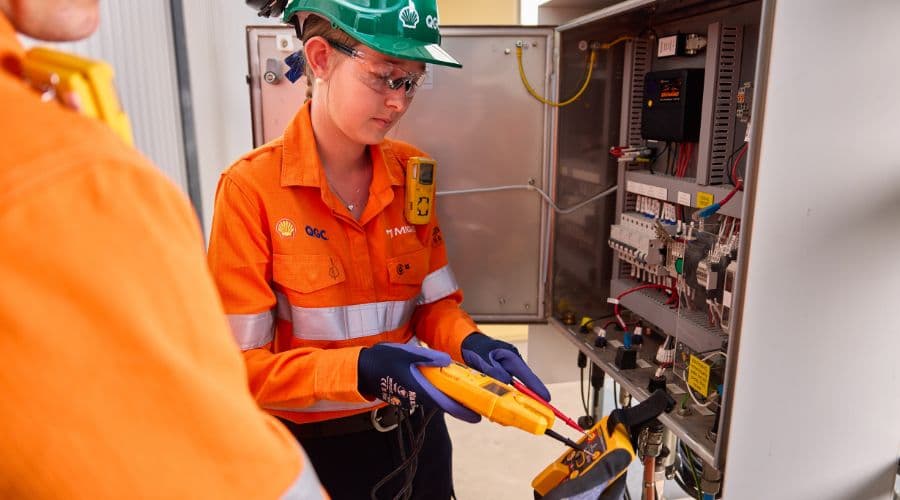
MIGAS Electrical and Instrumentation Apprentice, Aysha, undertaking their training with Shell's QGC business.
How Long is an Electrical and Instrumentation Apprenticeship?
An Electrical and Instrumentation Apprenticeship is a 5-year dual trade program, during which you'll complete two nationally recognised qualifications:
- UEE30820 Certificate III in Electrotechnology Electrician
- UEE31225 Certificate III in Instrumentation and Control
Five years is a genuine commitment, but you'll graduate with something most tradespeople spend a career working toward: full competency across two complementary disciplines, and the formal qualifications to prove it.
You'll be paid throughout your apprenticeship, gaining hands-on experience under qualified technicians while studying through a Registered Training Organisation. Depending on your state or territory, you'll also need to apply for an electrical licence on completion.
Electrical and Instrumentation Technician Salary
In 2026, qualified Instrumentation Technicians in Australia typically earn from $70,000 to $90,000 per year, with salaries for dual trade Electrical and Instrumentation Technicians in mining, oil and gas, processing and FIFO roles more often exceeding $120,000. (Seek)
The dual qualification combines electrical trade skills with instrumentation, automation and process control expertise, making E&I technicians highly sought after across Australia's energy, mining and industrial sectors.
Electrical and Instrumentation Apprentice Wages
Electrical and Instrumentation Apprentices are usually paid under the Electrical, Electronic and Communications Contracting Award or an employer-specific EBA. Apprentice wages increase each year as you progress through your training and develop both electrical and instrumentation competencies.
Your weekly pay can vary depending on factors such as whether you've completed Year 12, whether you're an adult apprentice, any EBA conditions, employer or host benefits, and relevant government support.
Indicative weekly Award wages for an electrical and instrumentation apprentice as at 1 July 2026, ranging from 1st year to 4th year:
- Junior apprentice, did not complete Year 12: $622.72 to $1,006.97 per week
- Junior apprentice, completed Year 12: $682.76 to $1,006.97 per week
- Adult apprentice (21 years and over): $982.95 to $1,098.29 per week
(Source: Fair Work Ombudsman Pay Guide MA000025)
These minimum rates include applicable industry, tool and electrician's licence allowances under the Award. Depending on the employer, location and industry sector, apprentices may also receive additional payments such as overtime, site allowances and remote work penalties. Read more in our 2026-27 Apprentice Wages Guide.
Skills and Requirements
An Electrical and Instrumentation apprenticeship is technically challenging and physically demanding, but for the right person it offers strong long-term career prospects across some of Australia's most stable industries.
Successful apprentices tend to share these attributes:
- Electrical aptitude: A solid grasp of electrical and electronic principles, with confidence working across both power systems and low-current signal-level systems
- Diagnostic abilities: Much of the job is finding the cause of faults in complex systems, so analytical thinking and structured troubleshooting are essential
- Maths skills: Calculations, calibration and interpreting technical data are part of the daily work
- Attention to detail: Calibration and accuracy directly affect safety, product quality and process efficiency
- Normal colour vision: Many components are colour-coded, and accurate identification matters for safe and correct installation
- Manual dexterity: Working with delicate instruments and small components requires steady hands and fine motor control
- Communication skills: Technicians work alongside engineers, operators and other tradespeople, so being able to explain technical detail clearly matters
- Commitment to safety: A genuine willingness to learn and apply health, safety and environment principles every day on site
Most employers and Registered Training Organisations expect candidates to have completed Year 12 with passes in English and Maths. You'll also need reliable transport and the ability to obtain a provisional driver's licence within the first 12 months.
Host employers, particularly in mining and resources, generally require candidates to pass a pre-employment medical and drug and alcohol screening.
Career Pathways After Your Apprenticeship
A dual Electrical and Instrumentation qualification is one of the most valuable trade credentials available in Australia, opening doors across the country's highest-paying industries:
- Mining, oil and gas (including FIFO roles)
- Power generation and renewables
- Water and wastewater treatment
- Food and beverage manufacturing
- Pharmaceuticals and chemicals
- Process automation and control systems
- SCADA and PLC programming
- Functional safety and hazardous area work
- Engineering technician roles (with further study)
- Site supervision, project management and contracting
A trade qualification is one of the most portable and resilient credentials you can earn, and a dual qualification doubles your options. Electrical and Instrumentation technicians are needed wherever industrial processes run.
Find an Electrical and Instrumentation Apprenticeship
Electrical and Instrumentation is one of the most sought-after dual trades in Australia, with opportunities across mining, oil and gas, energy and heavy industry. MIGAS works with leading host employers including Origin Energy and Shell's QGC business, where our apprentices undertake their training on major resource sector operations.
Browse the MIGAS Jobs Board for current Electrical and Instrumentation apprenticeship roles, or register with us to receive updates when new positions are added.
Latest Apprenticeships
Quick Links
An Electrical & Instrumentation Apprenticeship is a dual trade pathway within electrical trade specialisations. You might also consider an Instrumentation and Control Apprenticeship or an Electrician Apprenticeship on their own.
View the MIGAS Jobs Board for current electrical trade apprenticeships.