Persevere with Patience – An Apprenticeship Story
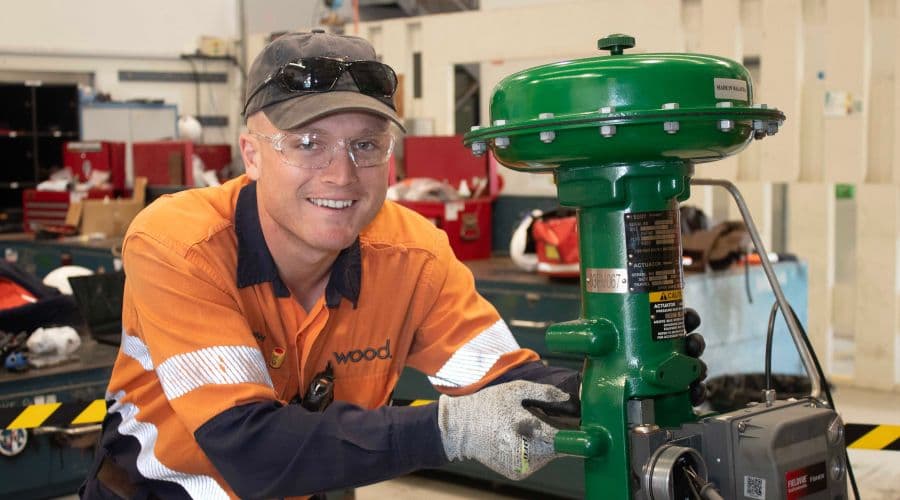
Completed MIGAS Electrical and Instrumentation Apprentice, Ryan, during his training with Wood
Ryan Edwards never planned on becoming an electrical instrumentation technician. He didn’t even know what one was.
He was at a course when a fitter asked what he wanted to do with his career.
“If I had my time again, I’d be an electrical instrumentation technician,” the man told him.
Ryan had no idea what that meant. He went home and googled electrical and instrumentation apprenticeship.
Five years, dual trade qualifications, and a site safety award later, Ryan has completed his apprenticeship with Wood at the Ampol refinery.
A Trade Found by Chance
Ryan grew up with an agricultural background in Gympie, Queensland, with no real connection to the trades that would shape his career. After finishing high school, he started a diesel fitting apprenticeship, but it never quite stuck.
“I enjoyed working on my personal vehicles more than I did other people’s,” Ryan said.
He was investigating a trade assistant role in the mines, and at a mining course had the conversation with the fitter that changed his direction entirely. A few family members already worked in the industry, and their advice sealed it:
“It’s a great trade,” he was told. “You stay cleaner than the other guys.”
After that, Ryan signed on for a dual trade apprenticeship in electrical and instrumentation, a five-year commitment. He started with another company before successfully moving his apprenticeship across to MIGAS Apprentices & Trainees and host employer Wood at the Ampol refinery, when the previous company ceased manufacturing.
The Hardest Part Wasn’t the Work
Ask Ryan about the toughest stretch of his apprenticeship, and the answer comes quickly. In his third year, he broke his collarbone away from work – an injury that could easily have set his progress to becoming qualified back four or five months.
Working in a vertical plant environment, there was no version of light duties that could bring him back on site safely.
“That was probably the difficult path for me to navigate, because I didn’t know what the expectation of the employer was,” Ryan said.
What followed surprised him. Rather than rushing him back, he was given the time to heal properly, and MIGAS made sure the setback didn’t cost him his progress.
“I was cleared to do TAFE work, and that allowed me to sit my theoretical components while I was still recovering,” Ryan said. “That was above and beyond effort from MIGAS.”
Without it, those months off would have pushed his completion date out considerably further.
The dual trade brought its own challenges, too. Working on an established site meant plenty of exposure to instrumentation work but far less hands-on electrical work, since most of it had already been done long before Ryan arrived.
Apprentices doing a straight electrical trade elsewhere were getting that hands-on practice every day; Ryan had to actively seek his out.
“You couldn’t possibly know what they knew, just because of the nature of where we worked,” he said.
The Penny Drop Moment
Jeff Browne has been part of Ryan’s apprenticeship since his very first day on the Ampol site.
“I’ve only been his direct supervisor for a few weeks now,” Jeff said, “but I was heavily involved with his apprenticeship as a tradesman.”
Jeff remembers it from the same angle Ryan does – the unequal exposure that comes with a dual trade on an established site, where the electrical work simply isn’t there to learn on the job the way it is elsewhere.
After discussion with Ryan, Jeff realised Ryan’s electrical fundamental knowledge was lacking as he wasn’t getting day-to-day exposure, and he made a call. As Ryan’s team leader at the time, he gave him an electrical control panel to build and told the rest of the team to leave him alone to figure it out.
“I know he’s a smart guy. He just hasn’t figured it out yet. The penny will drop,” Jeff recalled thinking.
“And you could see that change in him when the penny did drop. From there he flourished. He’s owning jobs now, and you can feel that confidence when you talk to him.”
Asked whether there was one particular moment he knew Ryan would make it, Jeff doesn’t hesitate.
“Not one particular moment. I always knew it, to be honest. I saw it in him from the start. I had no doubt at all,” he said.
“His fault-finding considers the overall process, not just his specific discipline. That mentality is far less common than one would think in this industry.”
Recognition, Completion
Of everything Ryan achieved during his apprenticeship, it’s a safety award he speaks about with the most pride. He was named one of three Safety Champions of the Year on site, after identifying a long-standing hazard that had gone unnoticed for years.
“Having young and fresh eyes that are attentive to detail, it improves everyone’s experience at that site,” Ryan said.
“When you go out and do things meaningfully, and you can deliver on change, it does really fulfil you.”
His training achievements were also recognised with a MiScholarship Award, MIGAS’s scholarship program for apprentices who go above and beyond in their studies.
When Ryan’s final sign-off came through, the relief was tied to one thing above all: finishing Capstone as a qualified electrician, the part of the dual trade he’d been least confident in.
“Once the electrical was done, I thought, well, the finish line, it’s there,” he said.
Now qualified, Ryan is looking forward to a large, programmed shutdown coming up at Ampol, a planned period where part of the site comes offline so major maintenance and overhaul work can happen safely.
It’s a rare opportunity to get hands-on with equipment and processes that simply aren’t accessible while the plant is running live, and Ryan is excited to make the most of it.
Advice For Those Starting Out
Ryan has no hesitation recommending a trade to anyone weighing it up.
“It’s a pretty bulletproof way to secure yourself some job redundancy,” he said. “It’s an experience that teaches you how to work with both your hands and your head.”
He’s candid about what doesn’t get talked about enough too: the adjustment of going from a classroom of people your own age to a job site where your closest colleagues might be twenty years older, with kids and a completely different life stage.
“That was a good bit for me, but it also proved tough,” Ryan said. “Backing yourself as a young person, being confident but also self-aware.”
His advice for getting through the tougher academic stretches is straightforward: speak up early.
“It’s 5 minutes now, or it’s going to be a hell of a lot more time after once that incorrect knowledge compounds.”
What carried him through, beyond the people directly supervising him, were the people willing to pass on what they knew.
There are too many to name, Ryan says, but two stand out: Glen McMurtrie from TAFE Queensland, “a wealth of knowledge that will always reciprocate the same respect that you give him,” and David Love, a tradesman with forty years of service at the same company, who handed down tools and specialised equipment when he retired.
“Dave taught me how to use and clean these tools before handing them down to me, to live on at another site. I hope the same tools can retire me some day,” Ryan said.
Looking back on his apprenticeship, Ryan’s takeaway is simple.
“Learn to persevere with patience and not be overconfident in what you think you know. There’s just more things to learn than anyone will ever have the chance to do.”
Sometimes all it takes is one conversation. Consider this yours. Browse apprenticeship jobs now.