How Long is an Engineering Apprenticeship?
Most engineering apprenticeships in Australia take four years to complete on a full-time basis. During that time you will combine on-the-job training in a real workplace with off-the-job study at a Registered Training Organisation, working toward a Certificate III in Engineering in your chosen trade specialisation.
Why Four Years?
Engineering trades involve complex, precision-based skills that take time to develop to a competent standard. The four-year duration reflects the depth of knowledge and practical experience required to work safely and effectively as a qualified engineering tradesperson across the range of tasks and environments these trades involve.
Australian Apprenticeships operate on a competency-based completion model, meaning you formally complete your apprenticeship when your employer and Registered Training Organisation are satisfied that you have demonstrated competency across all required units of your qualification.
In practice, most engineering apprentices complete within the four-year nominal timeframe, though motivated apprentices in well-structured placements may complete ahead of schedule.
If you have relevant prior experience or qualifications, Recognition of Prior Learning (RPL) may be available to credit some units toward your qualification. This is worth discussing with your employer and RTO at the start of your apprenticeship.
What Does the Training Involve?
Engineering apprenticeships combine two components that run alongside each other throughout the four years.
On-the-job training
The majority of your time is spent working in a real workplace under the supervision of qualified engineering tradespeople. You develop practical skills progressively, working with tools, machinery and equipment specific to your trade specialisation.
As you progress through each year level, you take on more complex work and greater responsibility, and your wage increases accordingly.
Off-the-job training
You also attend a Registered Training Organisation, typically a TAFE, for structured theoretical training at scheduled intervals throughout the year. This is usually delivered as block release, where you attend for a consecutive period of days or weeks several times a year.
Attendance is mandatory and forms a required part of your Training Contract.
Together, these two components lead to a nationally recognised Certificate III in Engineering in your trade specialisation.
Engineering Apprenticeship Trade Specialisations
Engineering apprenticeships cover two main trade categories, each with several specialisations.
Mechanical Engineering
Mechanical engineering apprenticeships focus on machinery and mechanical systems, covering installation, maintenance, troubleshooting and repair. These trades are primarily associated with fixed plant machinery in industries such as mining, manufacturing, oil and gas, power generation and green energy.
Mechanical engineering trade specialisations include:
- Mechanical Fitter Apprenticeship
- Fitter and Turner Apprenticeship
- Fitter Machinist Apprenticeship
- Toolmaker Apprenticeship
For a detailed comparison of the fitter specialisations, read our blog post Engineering Trade Apprenticeships: Comparing Fitter Specialisations.
Fabrication Engineering
Fabrication engineering apprenticeships focus on working with metal, cutting, shaping, joining and finishing it to manufacture, maintain or repair metal products and structures. Fabrication tradespeople work across manufacturing, construction, mining, shipbuilding, defence and heavy industry.
Fabrication engineering trade specialisations include:
What Qualification Do You Earn?
Most engineering apprenticeships lead to a Certificate III in Engineering in the relevant trade specialisation, such as:
- Certificate III in Engineering - Mechanical Trade (MEM30219) for mechanical engineering specialisations
- Certificate III in Engineering - Fabrication Trade (MEM31925) for fabrication specialisations
In some roles that involve a genuine mix of fixed and mobile plant work, you may undertake a Certificate III in Engineering - Fixed and Mobile Plant Mechanic (MEM31419).
These are nationally recognised qualifications under the Australian Qualifications Framework that carry weight with employers across the country and across industries.
Where Do Engineering Tradespeople Work?
Qualified engineering tradespeople work across a broad range of industries and settings. The portability of the qualification and the broad applicability of the skills mean you have genuine flexibility in where and how you build your career after qualifying.
Industries that employ engineering tradespeople include:
- Mining and resources, including FIFO roles
- Oil and gas, onshore and offshore
- Manufacturing and industrial production
- Green and clean energy, including wind, solar and hydrogen infrastructure
- Power generation and utilities
- Defence and aerospace
- Construction and infrastructure
- Transport and logistics
Is an Engineering Apprenticeship Right for You?
Engineering apprenticeships suit people who enjoy working with machinery and technical equipment, have an aptitude for precision work and take satisfaction in solving practical problems.
Prior study in mathematics, physics, engineering or metalwork at school is an advantage for most engineering trades, particularly the mechanical and fabrication specialisations.
If you are interested in exploring the different engineering trade specialisations available through MIGAS, browse current opportunities on our Jobs Board.
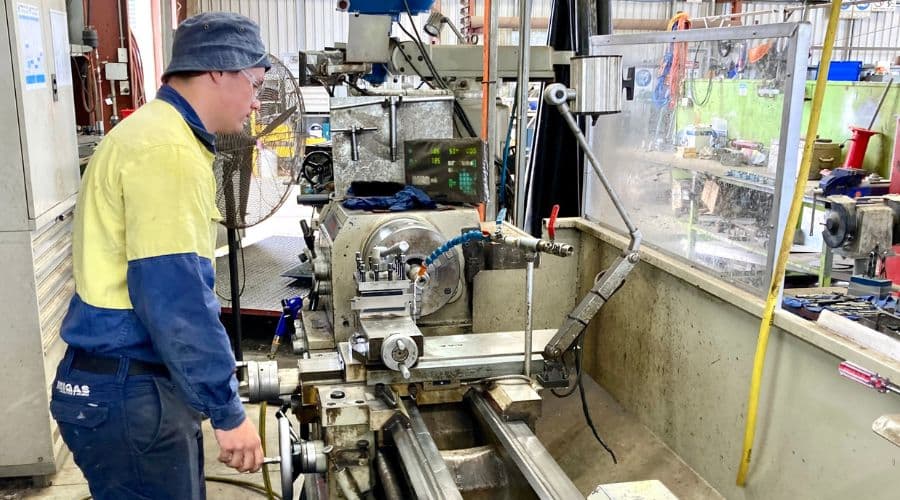
Clinton completed his Mechanical Fitter Apprenticeship with MIGAS and is now a qualified tradesperson.