How to Find an Electrical Apprenticeship
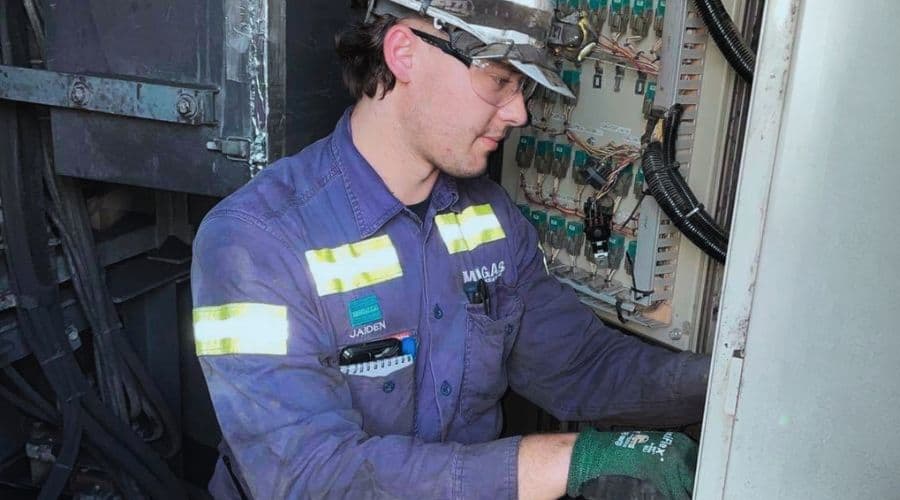
MIGAS apprentice Jaidan completed his Electrical Apprenticeship hosted with Bengalla Mining Company.
Electrical apprenticeships are some of the toughest to break into in Australia.
Many listings draw hundreds of applications for a single position. That level of competition can be discouraging, but most of the gap between candidates comes down to preparation rather than raw talent or connections.
The people who land these electrical apprenticeships have usually put in work well before they ever submitted an application. This article covers where that effort tends to pay off most.
Decide What Type of Electrical Work Suits You
Not all electrical apprenticeships look the same day to day, and it’s worth thinking about which environment suits you before you start applying, since it shapes everything from the physical demands of the job to the tickets worth getting first.
- Residential work covers wiring new homes, renovations, switchboard upgrades and general domestic maintenance. Crews are usually small, and you’ll deal directly with homeowners more than in any other setting.
- Commercial apprenticeships put you on office fit-outs, retail builds, schools and similar projects, usually on bigger sites with more trades working alongside each other and more structured project timelines.
- Industrial apprenticeships are based in manufacturing plants, processing facilities and mine sites. The work is heavier, shift patterns are common, and safety requirements are stricter than on a typical residential or commercial job.
- High voltage apprenticeships sit with the electricity distributors and transmission networks, the kind of employers covered later in this guide. Entry is competitive and usually comes with additional tickets and medicals, but the pay and long-term career path reflect that.
- Solar apprenticeships have grown quickly alongside residential and commercial solar and battery installs, and suit anyone who wants the technical side of electrical work without necessarily specialising in high voltage or heavy industrial settings.
None of these are locked in for life. Plenty of electricians move between different types of work over a career, but knowing roughly where you’d like to start makes it easier to target your applications and decide which tickets and experience to prioritise first.
Where to Find an Electrical Apprenticeship
When searching for electrical apprenticeship opportunities, these channels are worth adding to your list if they aren’t on it already. Some of them underused simply because fewer people know about them.
Job Boards
SEEK and Indeed remain the highest-volume job boards for advertised apprenticeship vacancies. Setting up alerts for terms like "electrical apprentice" and "apprentice electrician" saves you from searching manually every day.
Apprentice Connect Australia Providers
Apprentice Connect Australia Providers (ACAPs) are Commonwealth-funded services that support apprentices and employers through the entire training contract. There are usually 2-3 for each state and territory, and many publish their own job boards with direct relationships to local employers.
ACAPs include BUSY At Work (Apprenticeship Central job board), MEGT, Apprenticeship Support Australia, and MAS National.
Group Training Organisations
MIGAS is one Group Training Organisation (GTO) among many, and if a suitable role isn’t available with us in your timeframe or location, registering elsewhere widens your options.
Find local Group Training Organisations in your state or territory. Again, many have their own job boards with current apprenticeships, or you can register your interest.
Industry Employers
Large electrical companies typically run intakes annually or six-monthly. Most publish their intake dates well ahead of time and offer job alerts, so it’s worth registering interest even outside an active application window.
These include:
- Australian Capital Territory: Evoenergy
- New South Wales: Ausgrid, Endeavour Energy, Essential Energy, Transgrid
- Northern Territory: Power and Water Corporation, Territory Generation
- Queensland: Powerlink, Energex & Ergon Energy (Energy Queensland)
- South Australia: SA Power Networks
- Tasmania: TasNetworks
- Victoria: CitiPower & Powercor, AusNet Services
- Western Australia: Western Power, Horizon Power
These channels only get an application in front of someone. What happens next, how you prepare and present yourself, is what decides whether you get picked.
Treat Your Pre-Apprenticeship Like Your First Real Job
A pre-apprenticeship in Certificate II in Electrotechnology isn’t compulsory, but for anyone serious about the trade, it’s close to it.
The mistake many candidates make is treating it as a box to tick rather than a genuine tryout. This is your opportunity to really decide if becoming a sparky is really what you want.
Turn up early. Ask the trainer questions instead of coasting through the practical tasks. Finish every module properly, including the ones that feel repetitive.
Trainers see a lot of apprentices come through their courses, and employers often ask them directly who stood out. Being the student a trainer remembers for the right reasons is one of the more reliable, and least talked about, ways into a role.
It isn’t unusual for someone to land a placement halfway through their pre-apprenticeship because a trainer or a fellow student passed their name along.
Get Trade Work Experience Before You Apply
Classroom learning only tells an employer so much. Real, on-tools experience, even outside electrical work specifically, tells them you already know how to turn up to a work site, follow instructions and get through a physically demanding day.
Trades assistant and labouring roles are the most direct route. Electrical contractors, residential builders, civil contractors and mining services companies all take on TAs and labourers, and these positions are usually easier to get than an apprenticeship itself, since they don’t come with a training contract attached.
A few months of this kind of work, even on a general building site rather than an electrical job specifically, gives you something concrete to talk about in an interview and photos to add to your portfolio.
If you already know someone in the trade, whether it’s family or a contact from your pre-apprenticeship, ask them directly whether they’ll take you on for a few days of work experience or a paid trial.
Most electricians and contractors remember who asked properly and showed up on time far more than they remember a cold resume.
Sort Out Your Driver’s Licence Early
A current driver’s licence, ideally a manual one, is one of the more overlooked requirements for an electrical apprentice.
Many employers need apprentices who can drive between sites or collect materials, and a manual licence removes any doubt about which vehicles you’re able to operate.
If you’re still working through your licence stages, get ahead of it. Turning up to an interview without one, or without a clear plan to get one soon, is an easy way to be ruled out for reasons that have nothing to do with your aptitude for the trade.
Collect the Tickets That Signal Genuine Commitment
None of the following are compulsory for a first-year apprentice, and no single ticket will get you across the line on its own, but completing a White Card, an EWP ticket, First Aid, Working at Heights or Confined Spaces training on your own time tells an employer something a resume can’t: that you were prepared to invest in this trade before anyone was paying you to.
Check with the Group Training Organisation or employer you’re applying to about which tickets actually matter for the type of work on offer, since requirements shift a lot between a small residential contractor and a large industrial site.
Put Together a Portfolio You Can Actually Hand Over
A folder with printed copies of your tickets, photos of any practical work you’ve completed (school projects if recent and relevant, pre-apprenticeship tasks, previous trade jobs), your resume, a tailored cover letter, and any test results you’re proud of gives an employer something concrete to look at.
Digital copies have their place, but a physical, well-organised folder still stands out in a face-to-face interview, particularly against a stack of near-identical resumes.
Plastic sleeves and a sensible contents order are enough. It doesn’t need to be elaborate.
Brush Up on Your Maths Skills
Numeracy and basic physics show up early, in aptitude tests during recruitment, and again once you start the electrical theory component of your training.
If high school maths feels like a long time ago, work on it before you need it rather than during an interview process.
Free numeracy practice tests are widely available online, and even a modest daily habit in the weeks before you apply makes a real difference to how confident you feel sitting one.
Understand How and When Roles Actually Open Up
Large employers with structured apprentice programs, including MIGAS host employers such as Bengalla Mining, Shell QGC, and Origin Energy, tend to run their intakes on a set annual cycle, either directly or through a Group Training Organisation. If you miss one of these intake windows, you’re generally waiting for the next one, so it’s worth knowing the cycle for the employers you’re targeting.
Outside of these structured intakes, a lot of positions open up throughout the year as businesses need people, and they don’t always get advertised widely online, particularly with smaller contractors.
Registering with Group Training Organisations like MIGAS means you’re in the running for roles as they come up, not only the ones that make it onto a jobs board.
It’s also worth keeping an ear out through pre-apprenticeship classmates, trainers, past students and anyone already working in the trade about who’s currently hiring.
Make Every Application Count
Submit a genuine resume and cover letter for every role, addressed to the specific position and company rather than a generic version sent everywhere.
Quick apply options on some job boards make it tempting to fire off high volumes of applications, but skipping a tailored cover letter can read as a lack of real interest in that particular role.
Work through the requirements listed in the job ad and respond to them directly in your cover letter and resume.
If you're applying through an online portal, mirror the specific wording used in the position description, and make sure you've answered every point in the selection criteria. Some employers and recruitment agencies screen applications automatically or with AI (MIGAS doesn't), and a resume that doesn't closely reflect the listed criteria can be filtered out before a person ever sees it.
Once you're applying in volume, across SEEK, Indeed, GTO job boards and direct approaches to employers (see a list of places to apply above), it's easy to lose track of what you've sent where. Keep a simple record: employer, role, date applied, and the outcome or follow-up date.
Prepare for the Practical Stage and the Interview
Some larger employers include a practical task as part of the hiring process, things like stripping cable or basic hand tool use, so any hands-on time you can get beforehand, including asking to practise during your pre-apprenticeship or work experience, will help.
On the interview side, the standard questions come up again and again: why you want to be an electrician, how you’ve handled a challenge at work, what you understand about the four-year commitment, and what you already know about the business you’re interviewing with.
Our 10 Apprentice Interview Questions and Example Answers is a good starting point. Practise your answers out loud beforehand rather than relying on getting them right on the day.
Dress cleanly in tradie gear rather than a suit. Turning up overdressed reads as unfamiliarity with the industry just as much as turning up scruffy does.
Arrive a few minutes early and bring a hard copy of your resume and portfolio even if you’ve already applied online.
Having a couple of considered questions ready for the interviewer tells them you’ve thought about this role specifically, rather than applying for everything in sight.
Look Beyond the Standard Electrician Pathway
Electrician is the best-known trade in this space, but it isn’t the only one. Air conditioning and refrigeration, security systems, data and voice communications and instrumentation and control apprenticeships all sit within the broader electrical trades family, use overlapping skills, and often draw fewer applicants per role than the standard electrician apprenticeship.
If your interest in electrical work is genuine rather than tied to one specific job title, widening your search across these related trades can shorten how long it takes to land a placement considerably.
Expect the Process to Take Time
For a lot of successful electrical applicants, the path from first application to signed apprenticeship runs somewhere between six months and a year, sometimes longer, and it’s rarely a straight line.
Staying in paid work while you search, picking up trade-adjacent experience where you can, and using quieter stretches to add another ticket or brush up your maths all keep you moving forward instead of just waiting on a reply.
Keep working through employer options, and keep your portfolio and tickets current so you’re ready the moment the right opportunity comes up.
Persistence counts for as much as any qualification in this process, and it’s the one factor entirely within your control.