Mature Age Apprenticeships in Australia
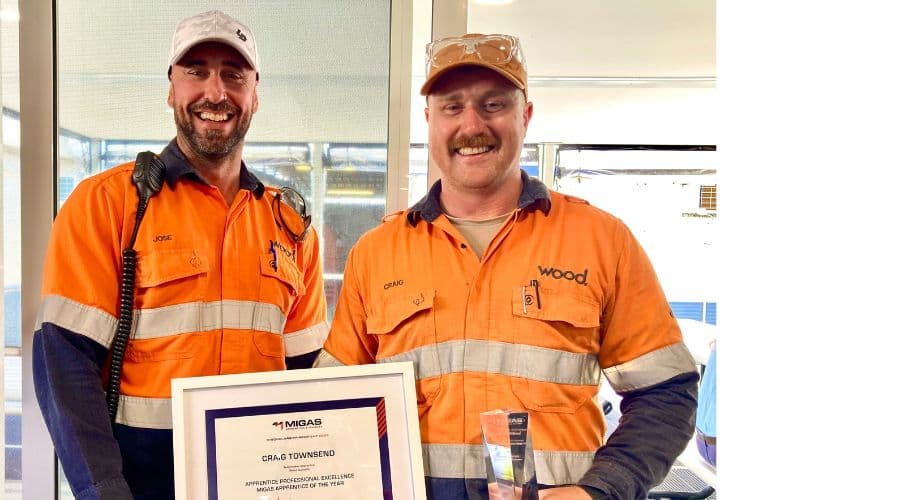
Craig (pictured right) commenced his Boilermaker Apprenticeship as a mature age candidate. Hosted with Wood Australia, he was named the 2025 MIGAS Apprentice of the Year and MiScholarship recipient.
Switching into a trade in your late twenties, thirties, or forties is a real decision with real consequences.
The pay is lower, the body works harder, and you'll be back to being a first year when you're used to knowing your job.
The upside is a recognised qualification, real long-term earning potential, work that’s unlikely to be automated out from under you, and the option to work for yourself once you're qualified.
This article is for people who are thinking seriously about it. It covers what a mature age apprenticeship actually is, what you’re likely to earn, the changes to government incentives that came in on 1 January 2026, and the realities that don’t always make it into the marketing.
What Counts as a Mature Age Apprentice
In Australia, a mature age apprentice is anyone who is 21 or older when they start their apprenticeship. This threshold matters because it triggers higher minimum wages under most modern awards.
Below 21, apprentices are paid on a junior rate scale tied to age. From 21 onwards, the adult apprentice rate kicks in.
There’s no upper age limit. Some apprentices start their training well into their forties and go on to qualify and build careers in their new trade.
The Wage Reality
This is the single biggest thing to get clear about before you commit. First year apprentice wages, even on the adult rate, are well below what most people earn in established jobs.
The exact figure depends on the modern award covering the trade and any enterprise agreement the employer is operating under, but the gap between what you’re earning now and what you’ll earn in year one of an apprenticeship is likely to be significant.
The wage scales up each year. By year three or four, you’re on a percentage of the qualified tradesperson rate that’s much closer to a real wage. Once you’re qualified, depending on the trade and the industry, the earning potential is genuinely strong, particularly in mining, resources, and the higher-paying construction sectors.
You can get a current estimate of award wages for your trade and year of apprenticeship using the Fair Work Ombudsman's Pay Calculator.
If you’re carrying a mortgage, rent, or dependents, sit down with the numbers before you sign anything. Map out the four-year arc. Work out what you can absorb, what your partner is contributing, and whether your household can hold the line through year one and year two when the wage hurts most.
Plenty of mature age apprentices make it work, but the ones who succeed are the ones who went in with a financial plan, not a hope.
Not Every Employer Wants to Hire a Mature Age Apprentice
Mature age apprenticeships can be harder to find than ones aimed at school leavers, and there's a straightforward reason why. A mature age apprentice on the adult rate costs the business more than a 17 or 18 year old on a junior rate, especially in year one. Some employers prefer the lower-cost option, and there's a common assumption that younger apprentices are easier to train from scratch.
The flip side is that the employers who do hire mature age apprentices generally know what they’re getting. They’re looking for reliability, work ethic, and someone who shows up on time and follows through.
Mature age apprentices tend to bring all three. If you can demonstrate that in your application and interview, you’re competing on different ground to the 17 year olds.
It’s worth knowing that mature age apprenticeships are more commonly available in some industries than others. Mining, resources, defence, civil construction, and large industrial employers tend to be more open to hiring mature age apprentices than small residential trades businesses, partly because they’re structured to absorb the wage difference and partly because they value the work ethic that often comes with it.
Government Incentives Changed on 1 January 2026
The Australian Government overhauled the apprentice incentive system at the start of the year, and the new structure has implications for apprentices and the employers considering hiring them.
Most incentives are tied to the Australian Apprenticeships Priority List, maintained by the federal government to identify trades and occupations in national skills shortage.
Trades on the list attract financial incentives to encourage people into them. Trades not on the list don't (though state-based support may still apply).
As of January 2026, the list includes most traditional apprenticeship trades, including electricians, carpenters, mechanical fitters, boilermakers, automotive mechanics, and refrigeration mechanics.
The Key Apprenticeship Program (KAP)
KAP is the new top tier of support, designed to push apprentices and employers into trades that the government considers critical: clean energy and housing construction.
Eligible apprentices in KAP-listed occupations can receive up to $10,000 in support payments across their apprenticeship.
A particular trade qualifies for KAP if it's linked to a qualification on the Australian Apprenticeships Priority List, and the employer can provide genuine work in the clean energy or housing construction sectors.
An electrician working on residential housing is more likely to qualify than one doing general commercial maintenance, for example.
Australian Apprentice Training Support Payment
For trades on the Priority List that aren't covered by KAP, eligible apprentices may receive up to $2,500 through the Australian Apprentice Training Support Payment.
The payment is made in instalments across the first two years of the apprenticeship to assist with cost-of-living pressures.
Additional financial support
Two things stayed the same and are worth knowing about:
- Living Away From Home Allowance (LAFHA): If you have to move away from your usual home to take up an apprenticeship, you may be eligible for weekly payments to help cover the cost. This is particularly relevant for mature age candidates relocating for work in regional or mining areas.
- Australian Apprentice Support Loans (AASL): Interest-free loans up to $27,048 (in 2026-2027) to help with the costs of doing an apprenticeship, paid monthly. Repayments only kick in once your income passes the threshold (currently $69,528), and there’s a 20 percent discount if you complete your apprenticeship.
If you’re carrying mortgage and family commitments into a first year apprenticeship, both of these are worth investigating as well as additional financial assistance for apprentices.
Choosing the Right Trade
Mature age candidates often need to make a better trade decision than school leavers, because they have less time to course-correct if they pick wrong.
A few things worth weighing:
- Long-term earning potential. Some trades pay better than others, especially when you factor in the industries they typically lead into. An electrician in mining typically earns more than one doing residential work.
- Physical demands. All trades are physical to varying degrees. Some are harder on the body over time than others. Worth thinking about realistically given your age and any pre-existing conditions.
- Pathway off the tools. Most trades open up routes into supervision, estimating, business ownership, or specialised technical roles after a few years qualified. If you’re thinking long-term, the off-the-tools pathway in your trade matters as much as the on-the-tools work.
- Demand in your region. Some trades are desperately needed in some parts of the country and oversupplied in others. Apprenticeships exist within the realities of the local job market, especially if you don’t want to relocate.
- Incentive eligibility. As above, some trades attract more government support than others. This affects you and the willingness of employers to hire.
To work through these factors trade by trade, our trade specialisation pages set out what each apprenticeship involves, the typical pathways it opens up, and where the work tends to be across engineering, electrical, automotive and construction.
Applying as a Mature Age Candidate
Your application is fundamentally different from a school leaver’s, and you should treat it that way. You’re not competing on potential. You’re competing on track record.
Lead with the things a school leaver may not offer:
- Reliability: Show employers your work history. If you’ve held jobs for years at a time, that’s a significant point of difference.
- Transferable skills: Customer service, time management, working under pressure, operating equipment, working safely, leading small teams. All of these are valuable in trade settings.
- A clear reason for the change: Employers worry about mature age apprentices being a flight risk. “I’m doing this because I’ve thought about it for years and I’m committed” goes a long way. So does evidence of having researched the trade properly.
- Physical readiness: If you’ve been doing physical work, say so. Trade work can be hard on the body and employers want to know you can handle it.
Don’t pretend the wage drop hasn’t crossed your mind. If an employer asks how you’ll manage financially, give them an honest, considered answer. “I’ve worked out a budget with my partner and we’re prepared for the first two years” is a much stronger response than dodging the question.
When you reach the interview stage, our guide to common apprentice interview questions and example answers covers what employers tend to ask and how to respond, including how to handle the money conversation honestly rather than sidestepping it.
Questions to ask before you sign
Once you’re close to a job offer, there are things worth getting clear on before the employment contract is signed:
- What’s the wage in year one, and how does it scale across the four years?
- Does the employer pay above award, and if so, how much?
- Is there an enterprise agreement (EBA)? If yes, ask to see the relevant rates.
- Who covers off-the-job training costs? In most cases, apprentices don’t pay college fees, but it’s worth confirming.
- Is there a tool allowance, uniform allowance, or PPE provided?
- What are the working hours, and is overtime available?
- What financial support and incentives am I eligible for? (See Finance Assistance for Apprentices for an overview)
Make an Informed Decision
Starting a trade apprenticeship as a mature age candidate is harder than starting one straight out of school. The wage hurts more, the available roles are fewer, and the financial pressure is greater.
None of that changes the fact that thousands of mature age apprentices start, finish, and build solid careers off the back of the qualification every year.
If you’re serious enough about the trade to stick it out, the pathway is open. It’s a four-year investment in a qualification that pays back for the rest of your working life.
When you're ready to apply, there are a few places to look:
- General job boards such as SEEK
- GTO job boards, including the MIGAS Jobs Board
- Apprentice Connect Australia Providers in your state or territory
- Direct applications to employers, particularly larger employers in mining, resources, and construction
Many employers run formal apprentice intakes once or twice a year. Intakes starting in January or February typically begin recruiting around six months earlier, so the best time to start looking for those is mid-year. If you're aiming for a specific intake, work backwards from the start date and start applying well in advance.